After the passing of the Messenger of Allah (SAW), Hazrat Abu Bakr (RA) became the Caliph of the entire Muslim empire. After assuming the Caliphate, turmoil spread in all directions as false prophets and apostates began to raise their heads. Hazrat Abu Bakr (RA), however, dealt with these problems firmly and decisively. One of the most prominent among them was Musaylimah al-Kadhdhab. He declared himself a prophet and gathered an army of 40,000 soldiers on the plain of Aqraba. A fierce battle known as the Battle of Yamama took place against them.
For this battle, the Muslim army set out from Madinah toward Yamama with 13,000 soldiers. Salim (RA) also marched alongside the others. Under the pressure of Musaylimah’s 40,000-strong army, the Muslims suffered some setbacks in the initial phase of the battle.
The commander, Hazrat Khalid ibn al-Walid (RA), reorganized the army and arranged it in an unprecedented manner. It is worth noting that when the Muslim forces began to retreat, Hazrat Salim (RA) cried out,
“Alas! Our condition during the time of the Messenger of Allah (SAW) was never like this.”
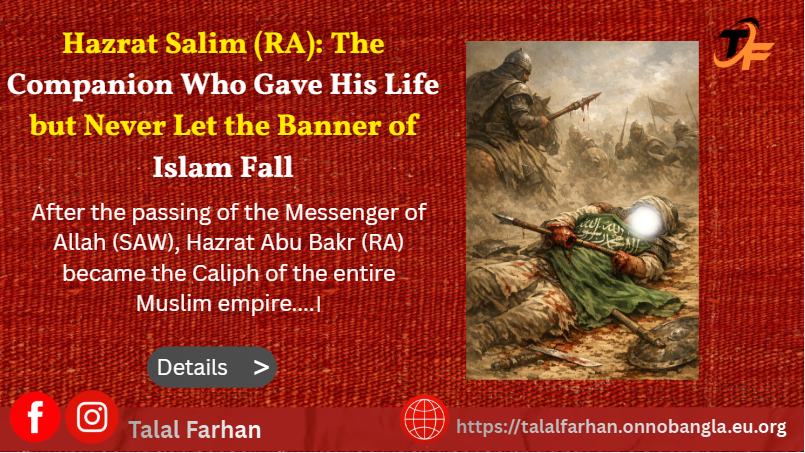
At the beginning of the Battle of Yamama, the banner of the Muslim army was carried by Hazrat Zayd ibn al-Khattab (RA), the elder brother of Hazrat Umar ibn al-Khattab (RA). After receiving repeated blows from the disbelievers, Hazrat Zayd ibn al-Khattab (RA) was eventually martyred, and the banner fell to the ground. Immediately, Salim (RA) picked it up.
At one stage of the battle, Salim (RA) saw that the enemy had surrounded his foster father, Hazrat Abu Hudhayfah (RA), striking him repeatedly until he attained martyrdom. On one hand, Abu Hudhayfah (RA) was crying out,
“O bearers of the Qur’an! Adorn the Qur’an through your actions!”
And on the other hand, he continued striking the army of Musaylimah al-Kadhdhab with his sword.
At that moment, an apostate struck Salim (RA) on his right hand, severing it. He raised the banner with his left hand. The enemies then struck his left hand as well, cutting it off. When both hands were severed, Hazrat Salim (RA) wrapped the banner around his neck and held it firmly.
In this state, he continued reciting the following verse of the Qur’an:
“Muhammad is no more than a Messenger. Many Messengers passed away before him. If he were to die or be killed, would you turn back on your heels? And many godly people fought alongside the prophets. They did not lose heart because of what afflicted them in the path of Allah, nor did they weaken or surrender. And Allah loves the steadfast.”
(Qur’an 3:144)
This was the slogan on his lips at the moment before his death.
Soon after, a group of apostates surrounded Salim (RA). The brave warrior, Hazrat Salim (RA), fell to the ground and attained martyrdom. With the killing of Musaylimah, the battle came to an end—marking victory for the Muslims and defeat for the apostates.
Afterward, the Muslims began searching for the wounded and the martyrs. Hazrat Salim (RA) smiled gently one last time—and spoke no further.
Both Hazrat Salim Mawla ibn Abi Hudhayfah (RA) and Hazrat Abu Hudhayfah (RA) attained what they had sincerely hoped for. They embraced Islam together, lived together, and were martyred together in the same place.
The story of Hazrat Salim Mawla ibn Abi Hudhayfah (RA) is similar to that of Bilal (RA) and other oppressed slave Companions. Islam broke the chains of slavery from their shoulders and elevated them to the ranks of imams, leaders, and administrators in a society founded upon truth and virtue. All the noble qualities of Islam were embodied in his character.
His most remarkable trait was that he openly spoke the truth as he knew it and never refrained from doing so. His fellow believers gave him the name:
“Salim min as-Saliheen” — Salim, one of the righteous.
Hazrat Umar ibn al-Khattab (RA) held Salim (RA) in the highest regard. Regarding the selection of the Caliph before his death, Hazrat Umar (RA) said:
“If Salim were alive today, I would have entrusted him with the responsibility of the Caliphate without even consulting the Shura.”